
Can I Prevent Diastasis Recti (Ab Separation) During Pregnancy?
Written and reviewed by Anna McMaster, PT, DPT, PRPC

As your belly grows during pregnancy, you might be wondering about those abdominal muscles and how they'll cope with all this stretching. If you've heard about diastasis recti (the separation of abdominal muscles during pregnancy) and want to be proactive, you're in the right place!
Understanding Diastasis Recti
Diastasis recti abdominis (DRA) occurs when the two parallel bands of your rectus abdominis muscles (your "six-pack") separate as your abdomen expands to accommodate your growing baby. This separation involves the stretching of the linea alba, the connective tissue that runs down the center of your abdomen. The truth is, some degree of separation is completely normal during pregnancy — studies show that up to 100% of women experience some separation by the third trimester. This isn't something to fear — it's your amazing body making space for your baby!
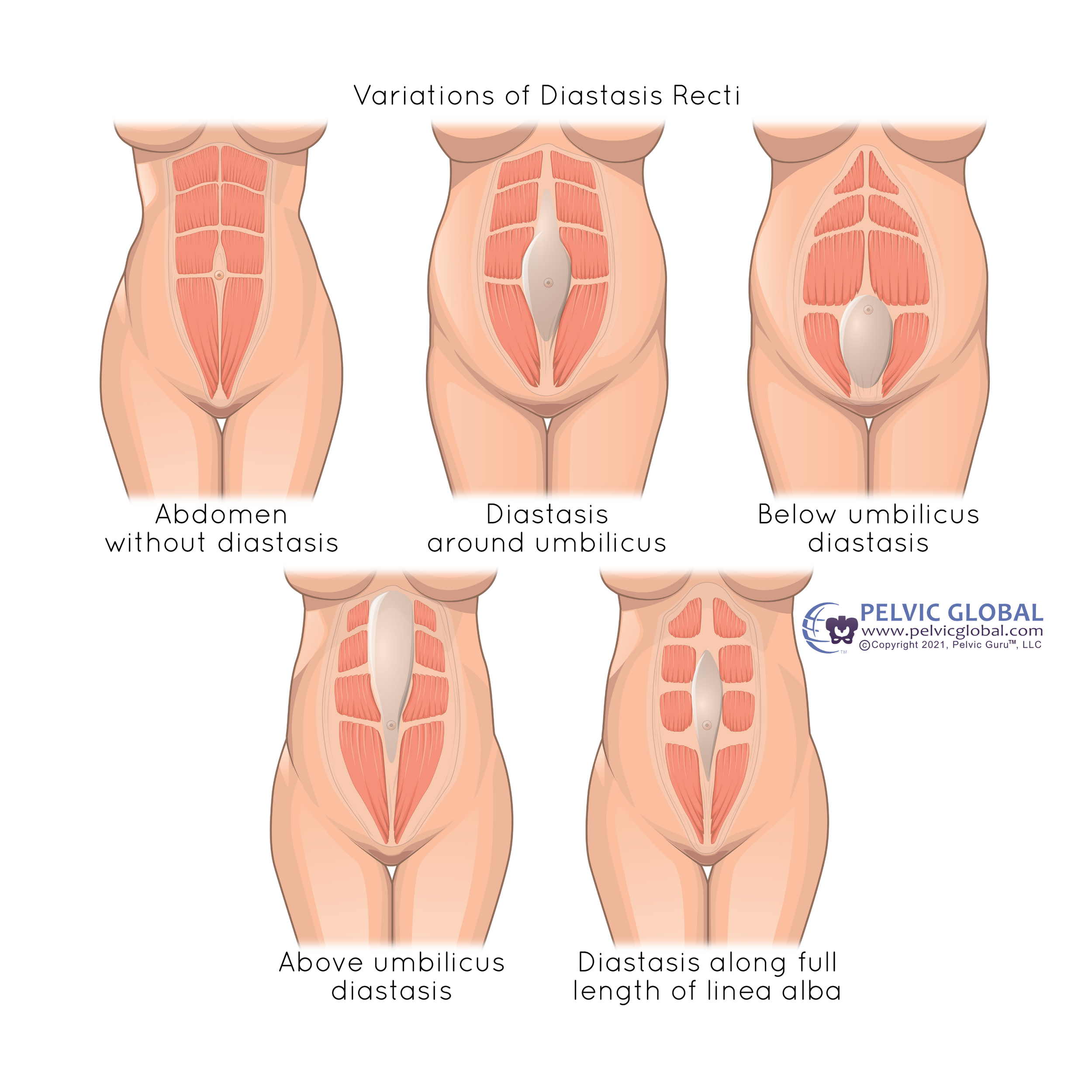
Image used with permission from Pelvic Guru®, LLC as a Pelvic Global Member
Here's something important that has shifted in our clinical understanding: we used to think the goal was simply to "close the gap." We now know that the width of the separation matters far less than the ability of the linea alba to generate tension. Research by Lee and Hodges (2016) was a landmark shift in how physical therapists approach DRA — showing that the linea alba's ability to create and maintain tension is what actually supports your abdominal contents and transfers force between the two sides of your core. A wider gap with good tension can function better than a narrower gap with poor tension. This is why counting finger-widths is much less meaningful than how your core actually functions.
Can You Prevent Diastasis Recti Completely?
Here's the honest answer: you cannot completely prevent diastasis recti during pregnancy. The expansion of your abdomen and the separation of these muscles is a natural and necessary part of pregnancy. However, research suggests you can take steps to minimize the severity of the separation, support your core during pregnancy, and set yourself up for better recovery postpartum.
Effective Strategies for Managing Diastasis Recti
The most important thing you can do is stay strong. Strength training during pregnancy — including squats, deadlifts, and other functional movements — is not only safe but beneficial for managing DRA. These movements, when performed with good form and appropriate load, help build the kind of whole-body strength that supports your core and prepares your body for the demands of pregnancy, labor, and postpartum recovery. The goal isn't to avoid loading your body — it's to load it well.
When it comes to core exercise specifically, the picture is more nuanced than the old "avoid crunches" rule suggests. Traditional ab exercises like crunches aren't categorically off the table — research shows that curl-up exercises can actually improve abdominal muscle strength without worsening DRA. What matters more is whether you can generate good tension across the linea alba during the movement, and whether your form holds up as you fatigue. Focus on exercises that engage your deeper core muscles — particularly the transverse abdominis, which works like an internal corset to support your growing belly — alongside your regular strength work.
You may have heard that doming — that visible ridge or bulging along your midline during exercise — means you should stop immediately. The current thinking is more nuanced: doming early in a set or with light loads is a signal worth paying attention to and may mean you need to modify the exercise, reduce reps, or build more foundational strength first. But it's a coaching cue, not a reason to stop training altogether. Doming that appears only when you're fatigued or at the end of a set is generally not a concern.
Good posture and mindful movement also matter day-to-day. Stand with your ribs stacked over your pelvis, avoid excessive arching in your lower back, roll to your side before sitting up from lying down, and bend from your knees when lifting. Some women also find relief with maternity support bands or compression garments, particularly during higher-intensity activity.
Exercise Warning Signs
Stop any exercise and consult your healthcare provider if you notice pain during or after exercise, inability to control urine or bowel movements during activity, or pelvic pressure or heaviness. Doming alone is not a reason to stop — but doming combined with any of the above symptoms is worth addressing with a pelvic floor PT.
Postpartum Recovery
Recovery takes time. Many women see significant improvement in the first 8-12 weeks postpartum, but full healing can take longer. Be patient with your body after birth and continue with appropriate exercises.
When to Seek Help
Consider consulting a women's health physical therapist or pelvic floor specialist if you're unsure which exercises are right for you, you have concerns about your technique, you're experiencing pain or discomfort, or you want personalized guidance during and after pregnancy. These specialists can assess your specific situation — not just the width of the gap, but how your core is actually functioning — and provide tailored recommendations.
The Bottom Line
While you can't completely prevent diastasis recti during pregnancy, you can be proactive about supporting your core and minimizing the severity through strength training, good movement patterns, and mindful breathing. Most women can significantly improve DRA after pregnancy with the right approach. This separation is a normal part of creating space for your growing baby — it's not a fitness failure or something you've done wrong. And remember: the goal isn't to close the gap. It's to build a core that functions well and feels strong. Taking care of your core now sets you up for a stronger recovery later.
For personalized guidance on managing diastasis recti throughout your pregnancy and beyond, Amie offers programs designed by pelvic floor PTs specifically for every stage of your journey.
References
Theodorsen N., et al. (2024). Pregnant women may exercise both abdominal and pelvic floor muscles during pregnancy without increasing the diastasis recti abdominis: a randomised trial. Journal of Physiotherapy, 70(1), 35-41.
Mota P., Pascoal A.G., Carita A.I., Bø K. (2015). Prevalence and risk factors of diastasis recti abdominis from late pregnancy to 6 months postpartum, and relationship with lumbo-pelvic pain. Manual Therapy, 20(1), 200-205.
Benjamin D.R., van de Water A.T., Peiris C.L. (2014). Effects of exercise on diastasis of the rectus abdominis muscle in the antenatal and postnatal periods: a systematic review. Physiotherapy, 100(1), 1-8.
Lee D., Hodges P.W. (2016). Behavior of the linea alba during a curl-up task in diastasis rectus abdominis: an observational study. Journal of Orthopaedic & Sports Physical Therapy, 46(7), 580-589.
Gluppe S.B., Ellström Engh M., Bø K. (2023). Curl-up exercises improve abdominal muscle strength without worsening inter-recti distance in women with diastasis recti abdominis postpartum: a randomised controlled trial. Journal of Physiotherapy, 69(3), 160-167.
Thabet A.A., Alshehri M.A. (2019). Efficacy of deep core stability exercise program in postpartum women with diastasis recti abdominis: a randomised controlled trial. Journal of Musculoskeletal & Neuronal Interactions, 19(1), 62.